
Hello all! Another season is upon us and I would like to welcome Courtney Cocheo (student at Johnson & Wales University in Rhode Island set to matriculate December 2024) to the scene. The following has been written by her and the recipe is absolutely fabulous. Give it a try and let me know your thoughts.

Now that the leaves are changing colors, and the weather is starting to cool down, this is the time where we put our autumn produce to use! This simple accompaniment or side dish is vegetarian and gluten-free but that doesn’t make it boring.. When mentioning fall, butternut squash is one of the many things that comes to mind! It is THE fall vegetable that can amp up any dish or have it be the star of the show.
This dish is packed with natural fiber (butternut squash, quinoa, kale, and apples). The benefits of fiber in the diet are endless. Some of the many benefits include improvement with bowel movement regulation, lowering LDL levels (the clinical abbreviation for the bad cholesterol), improved blood sugar regulation, and much more!
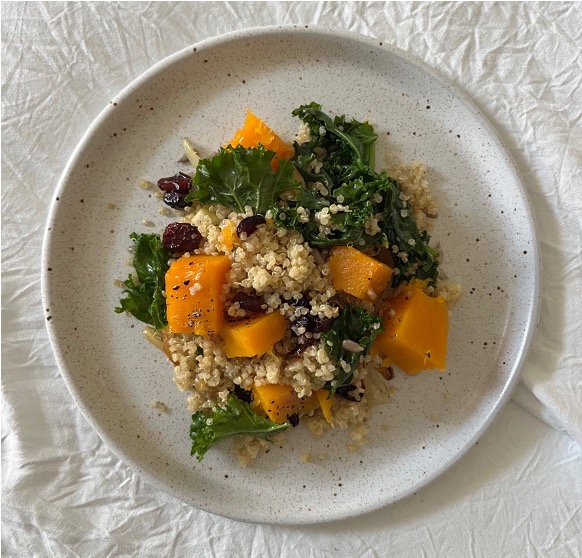
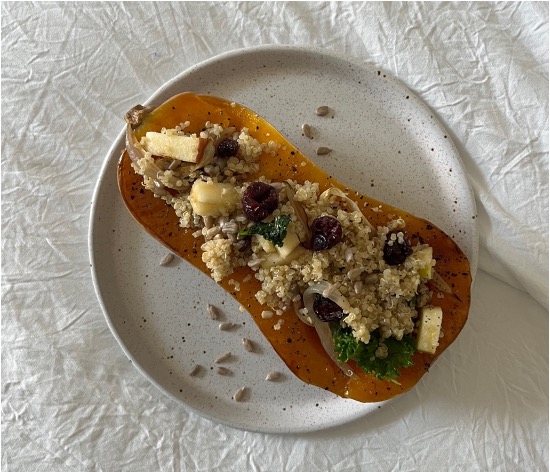
Butternut squash being the star of the show, can either be stuffed with our quinoa mixture or chopped up and mixed in with the quinoa. Not only is quinoa high in fiber as previously mentioned but it is also higher in protein than other grains. Quinoa is one of the grains that is considered a complete protein which means it contains all 9 essential amino acids that you need in your body. This is why many vegetarians and vegans love this ingredient! It is a great side dish for any fall gathering mixed with kale, almonds, cranberries, apples, and some other additives.
Kale is dark leafy green high in vitamins (A, B6, C, and K), folate, iron, and high in fiber which is our goal for this dish. Apples are another fall ingredient that elevates this dish. Apples are not just high in fiber but also vitamin C which is great when you are fighting a cold since it helps boost immunity when fighting infections! The old adage comes to mind: ‘An apple a day keeps the doctor away!’ Almonds are one of those nuts that are high in fiber, as well as high in calcium and great for your GI tract. Lastly, cranberries are full of vitamins and great for you in moderation. This is because if you use regular cranberries they include some sugar. Too much sugar can lead to raising blood sugar levels which isn’t so healthy. You want to consume 1/4 cup dried for one serving and one cup not dried.
This is a great savory fall and winter dish if you are looking for a crunchy texture with a hint of sweetness. Time to amp up your health!
Accompaniment to a Main Dish or Side Dish
Gluten-Free
Ingredients
Stuffing/Primary Base
1 cup dried quinoa (white or tricolor)
1 whole butternut squash or 4 cups of diced butternut squash
1/4 cup dried cranberries (sweetened or unsweetened)
1 small apple or 1/2 of a big apple (diced)
1/2 cup chopped almonds
1 cup kale (roughly chopped)
1/2 red onion
1 garlic clove
Salt + Pepper to taste
Tossed Dressing:
4 Tbsp lemon juice
1/4 cup olive oil
2 Tbsp apple cider vinegar
2 Tbsp Dijon mustard
Salt + Pepper to taste
Methodology
- Clean and prep squash if doing the stuffed method and cut in half. If not, peel and dice squash.
- Once diced or sliced/cleaned, place on a sheet pan with sliced onion, garlic, and drizzle with olive oil, salt, and pepper until tender.
- Cook quinoa as directed by package (normally 1 cup quinoa:1.5 cup water).
- Massage kale with olive oil, salt and pepper.
- To make the dressing, combine lemon juice, olive oil, mustard, and salt and pepper then mix!
- Once all components from steps 1-3 are cooked,combine with the chopped almonds, cranberries, quinoa, kale, and dressing.
- Stuff your cooked butternut squash or mix diced squash with quinoa mixture.
- Serve and enjoy!
Single Ingredient Benefits
Quinoa: high in fiber, vitamins, and minerals. Higher protein than other grains such as brown rice, couscous, oats, etc. Quinoa is naturally gluten free which is a good alternative for those with celiac disease, inflammatory conditions, or looking to clean up their diets. This super grain is considered to be a complete protein which means it contains all nine essential amino acids you need in your body.
Butternut Squash: great source of dietary fiber, which is essential for digestive health. It is full of vitamins and minerals such as vitamins C and A as well as potassium.
Kale: a vegetable that is rich in antioxidants, vitamins, and minerals, such as vitamin C and K, and folate. It is high in fiber. Many variations are dark green in color meaning that it is high in iron.
Almonds: a nut variety that is high in fiber and calcium. Like most fiber items this is great for your GI tract.
Cranberries: full of vitamins and great for you in moderation. Eating too many cranberries increases your consumption of sugar intake and also too many can not be so healthy for your liver. You want to consume 1/4 cup dried for one serving and one cup not dried.
 thefitbonvivant